Boiler Short-Cycling: Why an Oversized Boiler Costs You £250+ More Every Year
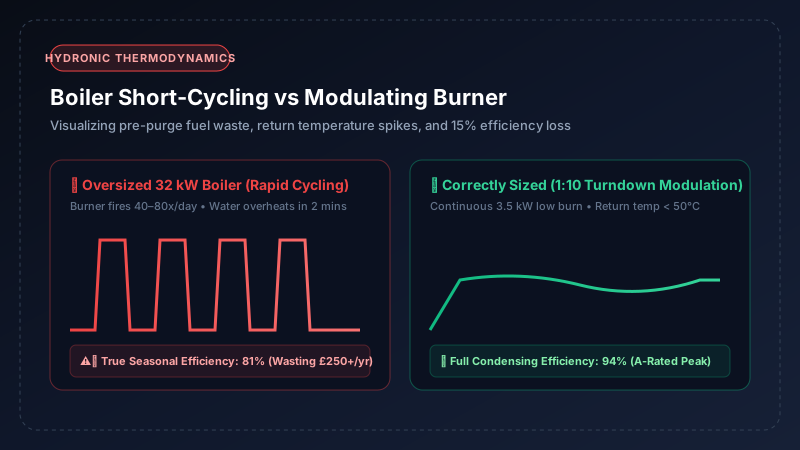
When replacing a central heating boiler, a pervasive myth dominates the residential heating industry: “It is always safer to fit a bigger boiler just in case.”
Homeowners and less-diligent installers frequently install 30 kW to 35 kW combi boilers in small-to-medium houses that have a true peak heat loss of only 6 kW to 9 kW. While conventional wisdom assumes the boiler will simply “run easily without straining,” the reality of hydronic thermodynamics proves the exact opposite: an oversized boiler causes chronic short-cycling, accelerating mechanical wear, spiking fuel consumption by 12% to 18%, and wasting upwards of £250 to £400 every winter.
In this comprehensive engineering analysis, we explore the mechanical causes of short-cycling, quantify the financial penalties through thermodynamic modeling, and provide actionable remedies to restore true 94% condensing efficiency.
1. What Exactly Is Boiler Short-Cycling?
A hydronic heating system relies on equilibrium between two thermal processes:
- Heat Generation: The boiler’s burner injects thermal energy into the circulating primary water.
- Heat Dissipation: The radiator circuit and underfloor heating loops transfer that energy into the ambient room air.
When a boiler is sized correctly, the burner modulates its flame down to match the exact rate of heat loss from the building. If a home is losing 4 kW of heat on an 8°C autumn afternoon, a modulating boiler fires continuously at 4 kW, maintaining a steady, low flow temperature.
The Oversized Boiler Failure Loop
When an oversized boiler (e.g. 32 kW with a poor 1:4 modulation ratio, meaning its lowest possible fire is 8 kW) operates in that same property:
- Massive Heat Injection: The boiler ignites at a minimum of 8 kW to 10 kW—injecting double the heat the radiators can emit.
- Rapid Return Water Surge: Because the radiators cannot shed heat fast enough, the return water rushes back into the boiler scaldingly hot within 90 to 180 seconds.
- High-Limit Thermostat Cut-Off: The internal flow and return thermistors detect that the water temperature has exceeded the target setpoint by +3°C to +5°C. The PCB abruptly cuts off the gas valve to prevent heat exchanger boiling.
- Pre-Purge & Post-Purge Thermal Dumping: The flue fan runs at high speed for 30 to 60 seconds before and after burner ignition, blowing cold outdoor air straight through the heat exchanger and dumping useful residual heat up the flue.
- Anti-Cycling Timer Delay: The boiler waits for an internal cooldown delay (typically 3 to 5 minutes) while the circulator pump pushes cooling water around the loop.
- Re-Ignition Shock: As soon as the timer elapses, the burner fires back up at maximum ignition power (often 70% to 100% load), and the destructive cycle repeats.
In severe cases, an oversized boiler can cycle on and off 40 to 100 times per 24-hour heating day, subjecting internal components to extreme thermal stress.
2. The 3 Hidden Costs of Boiler Short-Cycling
Short-cycling is not merely an annoying acoustic quirk; it imposes three direct penalties on your household finances and equipment lifespan.
A. The Flue Gas Pre-Purge Penalty
Every time a gas boiler ignites, safety regulations (BS EN 15502) mandate a pre-purge cycle. The fan draws ambient air across the burner chamber to expel any unburnt gas before the spark electrode strikes.
When a boiler cycles 60 times a day instead of firing continuously:
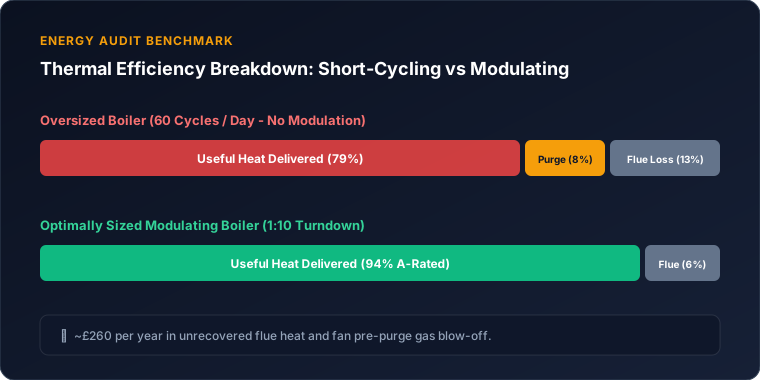
- The fan blows cold outdoor air through the hot primary heat exchanger 60 times, stripping out stored heat and sending it out the chimney.
- The gas valve opens at an elevated ignition rate before throttle stabilization, creating a momentary rich fuel burst.
- Standby Purge Losses account for 5% to 8% of total seasonal gas consumption on severely short-cycling systems.
B. Complete Disabling of Condensing Mode (Return Temp > 54°C)
Modern boilers achieve their advertised 92% to 94% ErP A-rated seasonal efficiency through latent heat recovery. When natural gas burns, hydrogen combines with oxygen to produce water vapour (H2O). A condensing boiler extracts the latent heat of vaporization (approx. 2.26 MJ/kg) by cooling the flue gases until this steam condenses back into liquid water.
The Thermodynamic Rule of Condensation:
Condensation of water vapor in natural gas flue exhaust only begins when the return water entering the boiler is below 54°C (130°F).
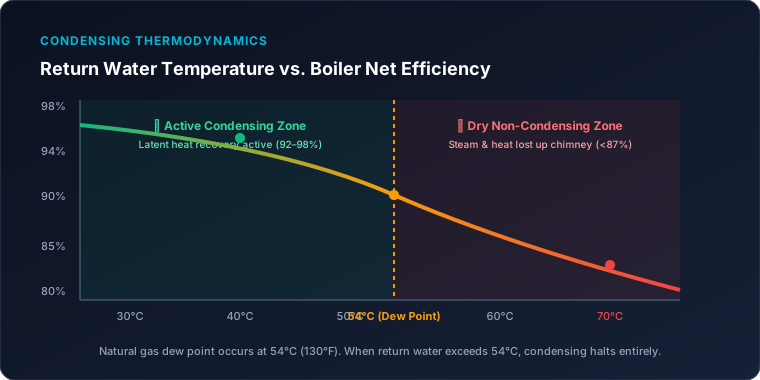
When an oversized boiler rapidly overheats the circulating water, return temperatures quickly climb to 65°C to 75°C. At these temperatures:
- No flue gas condensation occurs inside the secondary heat exchanger.
- The latent heat of vaporization escapes up the flue terminal as visible white steam.
- The boiler functions as an old, non-condensing appliance with a net operational efficiency of only 80% to 83%.
C. Premature Component Failure
The mechanical fatigue induced by rapid expansion and contraction drastically shortens component life:
- Ignition Spark Electrodes & Rectification Probes: Deteriorate 3x faster due to hundreds of thousands of ignition sparks.
- Gas Solenoid Valves & Relays: Subjected to mechanical chatter and wear.
- Printed Circuit Board (PCB) Relays: Premature relay failure from continuous high-amperage switching.
- Primary Heat Exchanger Stress Fractures: Constant thermal shock from 20°C temperature swings every 4 minutes.
3. Financial Impact: Real-World Annual Cost Modeling
To demonstrate the real-world cost, consider a typical 3-bedroom semi-detached UK home with an annual space heating demand of 12,000 kWh / year. At a standard natural gas price of 6.5p per kWh:
| Performance Metric | Correctly Sized Boiler (1:10 Modulation) | Oversized Boiler (Short-Cycling 1:4 Turndown) | Annual Penalty |
|---|---|---|---|
| Installed Boiler Size | 18 kW (Modulates down to 2.5 kW) | 32 kW (Modulates down to 8.0 kW) | +14 kW Oversized |
| Average Daily Cycles | 3 to 6 long continuous burns | 45 to 75 on/off bursts | 10x more mechanical wear |
| Average Return Temperature | 44°C (Deep condensing) | 67°C (Non-condensing) | Loss of latent recovery |
| Real-World Net Efficiency | 93.5% ErP A-Rated | 81.0% Real Seasonal | -12.5% Efficiency Drop |
| Annual Gas Required | 12,834 kWh | 14,815 kWh | +1,981 kWh wasted |
| Annual Space Heating Fuel Cost | £834.20 | £963.00 | +£128.80 / year |
| Standby Electrical Fan & Pump Draw | £22.50 | £58.00 | +£35.50 / year |
| Estimated Maintenance & Repair | £85.00 (Standard annual service) | £220.00 (Ignition/valve replacements) | +£135.00 / year |
| Total Annual Cost of Operation | £941.70 | £1,241.00 | +£299.30 Wasted Yearly |
Over an average boiler operating lifespan of 12 years, an oversized boiler wastes over £3,500 in avoidable fuel and repair bills.
4. How to Diagnose Short-Cycling in Your Home
You do not need specialized test equipment to verify whether your current boiler is short-cycling. Follow this simple 5-step diagnostic test:
The 15-Minute Burner Stopwatch Test
- Turn your central heating on and set your room thermostat to 22°C to ensure constant demand.
- Go to the boiler casing and observe the digital display or burner flame icon.
- Start a stopwatch when the flame ignites.
- Note how long the burner fires before cutting off:
- Healthy Sizing: The burner fires continuously for at least 20 to 45 minutes, modulating its flame down as rooms warm up.
- Moderate Short-Cycling: Burner fires for 6 to 10 minutes, shuts down for 3 minutes, then re-ignites.
- Severe Short-Cycling: Burner fires for under 3 minutes, shuts down, and rapidly repeats.
- Check the boiler’s display temperature: If the flow temperature climbs by more than 1°C every 5 seconds, the heat exchanger has inadequate water volume or massive excess burner power.
5. Engineering Remedies to Fix or Prevent Short-Cycling
If you are replacing a boiler or troubleshooting an existing installation, implement these engineering best practices:
1. Size Strictly to Room-by-Room Heat Loss (BS EN 12831)
Never size a boiler based on square footage rules-of-thumb or by counting old radiators. Use our dedicated Heat Loss Engine to calculate the true fabric and ventilation loss.
2. Prioritize Modulation Turndown Ratio (1:10 Standard)
When buying a combi boiler (which requires 30+ kW for instant hot water showers), choose a model with an ultra-wide modulation ratio:
- 1:10 Turndown: A 30 kW boiler throttles down to 3.0 kW (e.g. Worcester Bosch Greenstar 4000, Viessmann Vitodens 100-W).
- Avoid 1:4 Turndown Units: A 30 kW boiler that bottoms out at 7.5 kW will short-cycle throughout autumn and spring.
3. Electronic “Range Rating” (Software Down-Rating)
Most modern boilers allow a Gas Safe engineer to enter the installer parameter menu and electronically cap the maximum central heating output (kW) without affecting the hot water kW.
Example: You can software-lock a 32 kW combi boiler’s heating mode to a maximum of 10 kW, preventing burner overshoot while retaining 32 kW for instant high-flow showers.
4. Install Weather Compensation Controls
Weather compensation uses an external sensor mounted on a north-facing outdoor wall. When outdoor temperatures are mild (10°C), the control system automatically lowers the boiler flow temperature to 45°C. This forces continuous low-temperature burning, keeping return water in the optimal condensing sweet spot below 50°C.
5. Install a Low-Loss Header or Buffer Vessel
For complex multi-zone systems or older large-bore circuits, installing a hydraulic separator (low-loss header) or small 50L buffer tank decouples the boiler circuit from zone valves. This increases effective water volume and provides thermal inertia, eliminating rapid temperature spikes.
Frequently Asked Questions
Can an oversized boiler damage my radiators?
No, the radiators will not be physically damaged, but you will experience hot and cold room temperature swings, noisy thermal ticking as metal pipes rapidly expand, and uneven heat distribution where radiators close to the boiler get scorching hot while distant radiators remain lukewarm.
Does a boiler size calculator account for short-cycling?
Yes. Our Universal Boiler Sizing Calculator applies CIBSE and BS EN 12831 fabric heat loss algorithms to calculate the exact space heating kilowatt requirement and flags minimum modulation limits to prevent short-cycling.
Is short-cycling covered under manufacturer warranty?
Burner short-cycling caused by improper sizing or lack of hydraulic balancing is considered an installation defect, not a manufacturing fault. Premature electrode failure or fouled heat exchangers resulting from cycling are frequently rejected on warranty claims.
Related Heating Sizing Utilities:
Reviewed by James Davies, CEng MCIBSE
Lead heating consultant with 18+ years designing hydronic heating systems, district heat networks, and high-efficiency low-temperature heat pump integrations adhering to CIBSE and BS EN 12831 standards.