Combi vs System Boiler Sizing: Why System Boilers Require Fewer Kilowatts
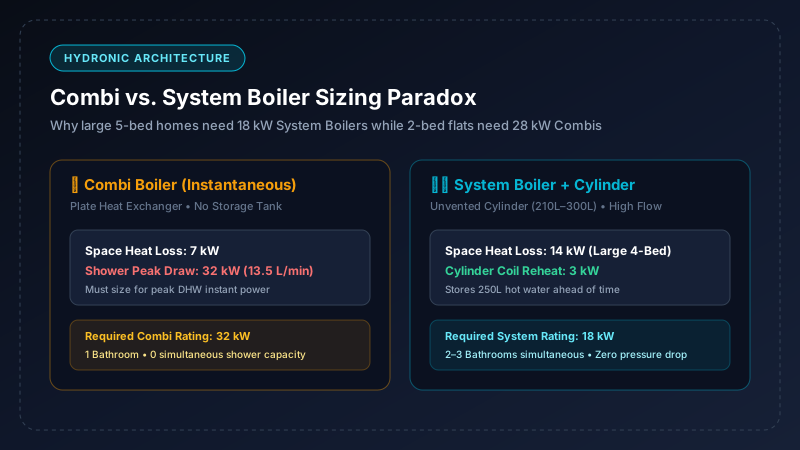
One of the most perplexing paradoxes for homeowners and property developers navigating central heating design is boiler output ratings.
Consider this real-world scenario:
- A compact 2-bedroom apartment with 1 bathroom is frequently specified with a 28 kW to 32 kW Combi Boiler.
- A sprawling 4-bedroom detached family home with 3 bathrooms and 18 radiators is properly specified with an 18 kW to 24 kW System Boiler.
Why does the larger building with double the radiator count require a boiler with half the kilowatt rating?
The explanation lies entirely in the physics of instantaneous domestic hot water (DHW) generation versus stored thermal energy. In this comprehensive engineering guide, we dissect the thermodynamic equations governing both systems, compare simultaneous flow rate performance, and provide a definitive decision matrix for your property.
1. The Physics of Heat Generation: Instant vs Stored
To understand why combi boilers require high kilowatt outputs, we must examine how thermal energy is transferred into tap water.
The Combi Boiler: Instantaneous Kinetic Heating
A combi (combination) boiler contains no internal water cylinder. When you turn on a hot tap or step into the shower:
- An internal paddle flow switch detects cold mains water entering the boiler.
- A motorized diverter valve shifts 100% of the boiler’s burner output away from central heating radiators into a compact plate-to-plate heat exchanger.
- Cold water at 10°C must be heated to a comfortable shower temperature of 42°C to 45°C in a single pass (a temperature rise Delta T of 32°C to 35°C) within 2 to 3 seconds.
To calculate the kilowatt energy required to heat flowing water instantly, we apply the specific heat formula of water (4.186 kJ/kg°C):
Required kW = (Flow Rate [L/min] × Delta T [°C] × 4.186) / 60Using this standard thermodynamic equation:
- A modest shower running at 10 Litres per minute with a 35°C temperature rise requires:
kW = (10 × 35 × 4.186) / 60 = 24.4 kW - A strong thermostatic shower running at 13 Litres per minute requires:
kW = (13 × 35 × 4.186) / 60 = 31.7 kW - A luxury overhead rainfall shower running at 16 Litres per minute requires:
kW = (16 × 35 × 4.186) / 60 = 39.1 kW
Key Insight: A combi boiler is not sized to heat your house; it is sized exclusively to deliver hot water to a single shower in real-time. The 28 kW to 35 kW rating is vastly oversized for the property’s 6 kW to 10 kW central heating demand.
The System Boiler: Indirect Stored Mass Buffer
A system boiler operates on a completely different hydraulic philosophy. Instead of trying to heat water instantly at the moment of use, a system boiler heats an insulated unvented hot water cylinder (such as a Telford Tempest or Kingspan MegaFlo 210L) ahead of time.
- The cylinder stores 150 to 300 Litres of domestic water pre-heated to 60°C.
- Inside the cylinder sits a high-surface-area corrugated stainless steel primary coil.
- When the cylinder’s internal dual-thermostat drops below 55°C, the boiler circulates primary water through the coil, transferring heat into the stored water over a 20 to 30 minute recovery window.
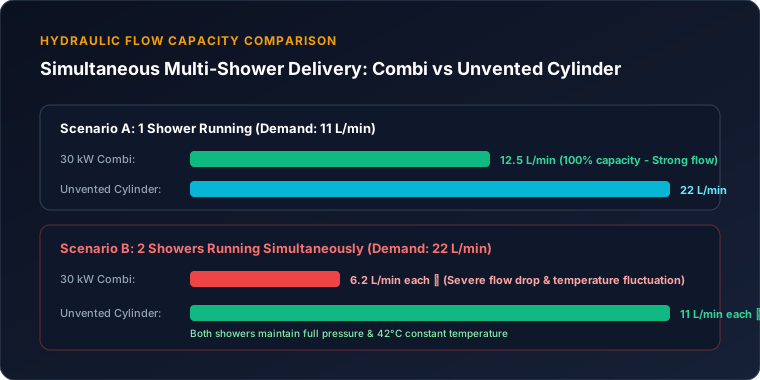
Because the thermal energy is stored in advance, when someone turns on two or three showers simultaneously, hot water is drawn directly from the cylinder at full mains flow rate. The boiler does not need to produce 70 kW of instant power; it simply needs 3 kW of reserve capacity to reheat the tank over half an hour.
2. The Complete System Boiler Sizing Formula
Under the CIBSE Domestic Heating Design Guide and BS EN 12831, sizing a system boiler is an exact, additive calculation:
System Boiler Size (kW) = Whole Building Heat Loss (kW) + Cylinder Reheat Allowance (kW)Real-World Calculation Example: 4-Bedroom Detached Home (210 m²)
Let’s calculate the system boiler size for a modern 4-bedroom detached home with 2 en-suites, 1 family bathroom, and 16 panel radiators:
- Fabric & Ventilation Heat Loss:
- Total floor area: 210 m²
- External design temperature: -3°C winter baseline
- Calculated room-by-room fabric heat loss: 12.4 kW
- Distribution & Pipework Allowance:
- Standard 10% uninsulated pipework factor:
12.4 × 0.10 = 1.24 kW - Total central heating load =
12.4 + 1.24 = 13.64 kW
- Standard 10% uninsulated pipework factor:
- Domestic Hot Water Cylinder Reheat Allowance:
- 210L unvented cylinder with high-recovery coil: 3.0 kW
- Total Boiler Rating Required:
Total kW = 13.64 kW + 3.0 kW = 16.64 kW
Engineering Conclusion: An 18 kW System Boiler (e.g. Vaillant ecoTEC plus 618 or Worcester Bosch Greenstar 4000 18kW System) is 100% adequate to power all 16 radiators while fully recovering the 210L hot water cylinder in 25 minutes.
Installing a 35 kW boiler in this home would be a severe 100% oversizing error, inducing burner short-cycling throughout the heating season.
3. Simultaneous Flow Rate & Bathroom Capacity Matrix
The table below illustrates the critical functional differences between combi and system boiler configurations under real-world household water draw:
| Household Requirement | Combi Boiler (28 kW – 32 kW) | High-Output Combi (38 kW – 42 kW) | System Boiler + 210L Cylinder | System Boiler + 300L Cylinder |
|---|---|---|---|---|
| Optimal Bathroom Count | 1 Bathroom | 1 to 2 Bathrooms | 2 to 3 Bathrooms | 3 to 5 Bathrooms |
| Simultaneous Showers | 1 Shower Only (6–12 L/min) | 1 Shower + 1 low tap | 2 Showers Simultaneously | 3+ Showers Simultaneously |
| Hot Water Flow at Delta T 35°C | 11.5 – 13.0 L/min | 15.5 – 17.5 L/min | 22.0 – 28.0 L/min (Mains dependent) | 28.0 – 35.0 L/min (Mains dependent) |
| Bath Fill Time (150L Bath) | 12 to 14 Minutes | 9 to 11 Minutes | 5 to 6 Minutes | 4 to 5 Minutes |
| Space Footprint Required | Single wall cupboard | Single wall cupboard | Boiler cupboard + Cylinder airing cupboard | Boiler cupboard + Large plant room |
| Loft Cold Water Tanks | None required | None required | None required (Sealed mains) | None required (Sealed mains) |
| Immersion Backup Heater | ❌ None (No hot water if boiler fails) | ❌ None | ✅ Yes (3 kW electric backup) | ✅ Yes (3 kW electric backup) |
| Solar / Heat Pump Integration | ❌ Difficult / incompatible | ❌ Incompatible | ✅ Twin-coil cylinder compatible | ✅ Highly compatible |
4. Decision Matrix: Which Architecture Fits Your Home?
Use this engineering decision flowchart to select the correct boiler type based on your property layout, mains flow rate, and occupancy patterns:
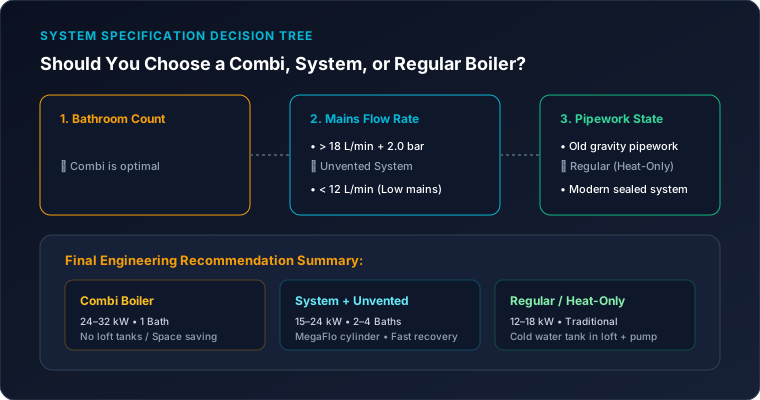
Choose a Combi Boiler If:
- Your home has 1 bathroom (or 1 main bathroom plus a downstairs cloakroom WC).
- You live in a flat, terraced home, or compact semi-detached property where living space is at a premium and you want to remove old hot water tanks to create cupboard storage.
- Household occupants rarely run a shower and a washing machine or bath at the exact same moment.
- Your incoming cold mains water flow rate is between 10 and 15 Litres per minute.
Choose a System Boiler with Unvented Cylinder If:
- Your home has 2 or more active bathrooms with morning rush-hour shower demand.
- You have high-flow thermostatic rainfall shower heads or large soaking bathtubs.
- Your incoming cold mains water delivers at least 18 to 22 Litres per minute at 2.5 bar pressure (which enables high-pressure multi-outlet delivery).
- You have an airing cupboard or utility room capable of accommodating a 600mm-diameter cylinder.
- You plan to integrate solar thermal roof panels or a hybrid heat pump in the future.
Keep a Regular (Heat-Only / Conventional) Boiler If:
- Your home has older thin-walled copper pipework or cast iron radiators that cannot withstand high mains water pressure (1.5 to 3.0 bar) without leaking.
- You have low incoming mains water pressure (< 10 L/min), requiring a gravity-fed cold water storage cistern in the loft to feed a traditional vented copper cylinder.
Frequently Asked Questions
Will a 42 kW combi boiler let me run two showers at once?
Technically, a 42 kW combi can deliver approximately 17 L/min at a 35°C temperature rise. If you run two standard eco-showers drawing 8 L/min each, it can supply both. However, if anyone opens a kitchen tap or flushes a toilet, both showers will experience noticeable pressure drops and temperature swings. For homes with 2+ bathrooms, a system boiler with an unvented cylinder remains the far superior engineering standard.
Does a hot water cylinder waste money on standing heat loss?
Modern ErP A-rated unvented cylinders feature 50mm to 60mm of high-density injected polyurethane foam insulation. Standing heat loss on a 210L cylinder is only 0.9 to 1.3 kWh per 24 hours—costing less than 8p to 10p per day in gas. Furthermore, that minor heat loss dissipates directly into the home’s thermal envelope, warming the airing cupboard.
Can I replace my system boiler with a combi to free up space?
Yes, provided your incoming mains flow rate is verified by an engineer (minimum 14 L/min) and you are willing to accept the single-shower operational limit.
Explore Specialized Sizing Tools:
Reviewed by James Davies, CEng MCIBSE
Lead heating consultant with 18+ years designing hydronic heating systems, district heat networks, and high-efficiency low-temperature heat pump integrations adhering to CIBSE and BS EN 12831 standards.