Radiator Heat Output: Understanding ΔT50 vs ΔT60 Corrections
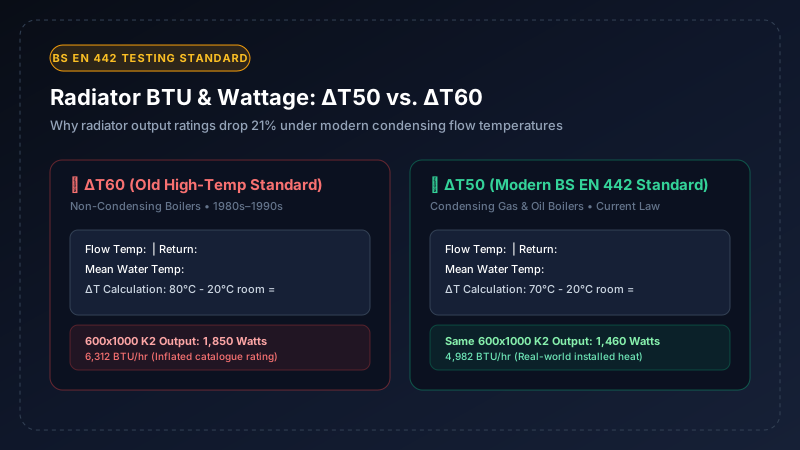
When specifying replacement radiators, designing central heating extensions, or measuring existing emitters to calculate required boiler capacity, one technical specification creates widespread confusion: Delta T (ΔT).
In manufacturer catalogues and retail websites, you will see radiators rated at either ΔT50 (Delta T 50) or ΔT60 (Delta T 60).
Using the wrong Delta T benchmark is not a minor rounding error—it results in a 21% to 27% miscalculation of radiator heat output. If you size your boiler based on ΔT60 catalogue numbers but operate your boiler at modern condensing temperatures, your home will be underheated on cold winter days.
In this authoritative engineering guide, we demystify the thermodynamics of radiator convection, explain the historical transition to the BS EN 442 European Standard, provide exact mathematical correction formulas, and explore panel construction profiles (K1, P+, K2).
1. What Exactly Is Delta T (ΔT) in Heating?
In hydronic engineering, Delta T (ΔT) represents the temperature differential between the mean water temperature (MWT) circulating inside the radiator and the ambient room air temperature.
The Mean Water Temperature Equation
Mean Water Temperature (MWT) = (Flow Temperature + Return Temperature) / 2
Delta T (ΔT) = Mean Water Temperature - Ambient Room Temperature
Under standard British design conditions (CIBSE Domestic Heating Design Guide), standard living space room temperature is set to 20°C (68°F).
Comparing the 3 Core Delta T Operating Regimes:
-
ΔT60 (The Legacy Standard - Pre-1997 / BS 3528):
- Flow Temperature: 85°C, Return Temperature: 75°C
- Mean Water Temperature: (85 + 75) / 2 = 80°C
ΔT = 80°C - 20°C = 60°C ΔT- Used on older non-condensing cast iron and open-flued boilers.
-
ΔT50 (The Modern European Standard - BS EN 442):
- Flow Temperature: 75°C, Return Temperature: 65°C
- Mean Water Temperature: (75 + 65) / 2 = 70°C
ΔT = 70°C - 20°C = 50°C ΔT- The mandatory legal testing baseline for all modern condensing boilers.
-
ΔT30 (Low-Temperature Heat Pump & High-Condensing Standard):
- Flow Temperature: 50°C, Return Temperature: 40°C
- Mean Water Temperature: (50 + 40) / 2 = 45°C
ΔT = 45°C - 20°C = 25°C to 30°C ΔT- Required for air source heat pumps (ASHPs) to achieve high seasonal coefficient of performance (SCOP > 3.8).
2. The Derating Curve: Mathematical Conversion Formula
Heat emission from a panel radiator occurs via two simultaneous physical mechanisms: radiation (infrared electromagnetic emission from the steel panel face) and convection (air moving upward through internal corrugated steel fins).
Because convective buoyancy is non-linear, radiator output does not scale in a simple straight line with water temperature. Under BS EN 442, radiator output at any operating Delta T is governed by the power law formula:
Actual Output = Tested Output at ΔT50 × (Operating ΔT / 50)^nWhere:
Actual Output= Heat output (Watts or BTU/hr)Operating ΔT= Actual system operating temperature differencen= Characteristic radiator exponent (typically n = 1.30 for steel convector panel radiators, or n = 1.25 for flat tube designer radiators).
Official Conversion Multipliers Table
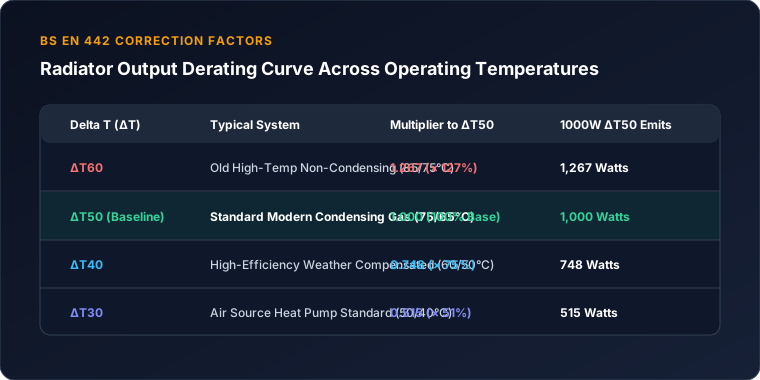
Use these certified CIBSE conversion factors to convert catalogue ratings to actual installed heat output:
| Operating Regime | Flow / Return Temp | Operating ΔT | Correction Factor (to ΔT50) | Example 1,000W ΔT50 Rad Emits |
|---|---|---|---|---|
| Old Non-Condensing | 85°C / 75°C | ΔT60 | × 1.267 | 1,267 Watts (4,323 BTU/hr) |
| BS EN 442 Baseline | 75°C / 65°C | ΔT50 | × 1.000 | 1,000 Watts (3,412 BTU/hr) |
| High-Efficiency Condensing | 65°C / 55°C | ΔT40 | × 0.748 | 748 Watts (2,552 BTU/hr) |
| Weather Compensated Mild | 55°C / 45°C | ΔT30 | × 0.515 | 515 Watts (1,757 BTU/hr) |
| Air Source Heat Pump (ASHP) | 45°C / 35°C | ΔT20 | × 0.304 | 304 Watts (1,037 BTU/hr) |
Beware of Retail Catalogue “Marketing Tricks”:
Some discount radiator retailers display output in large bold text using outdated ΔT60 ratings because the number looks 27% larger than the certified BS EN 442 ΔT50 rating. Always verify the rated Delta T before purchasing!
3. Radiator Panel Construction Profiles: K1, P+, K2
To deliver the required heat output without occupying excessive wall length, radiator manufacturers use different internal panel and convector fin arrangements:
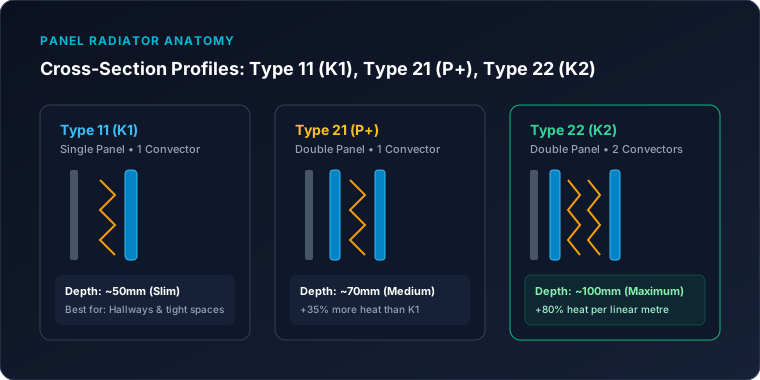
1. Type 11 / K1 (Single Panel, Single Convector)
- Construction: 1 front water-filled steel panel with 1 row of corrugated convector fins welded to the rear.
- Depth from Wall: Slim profile (approx. 50mm to 65mm).
- Best For: Narrow hallways, behind open doors, downstairs cloakrooms, and small utility rooms where wall projection must be minimized.
- Heat Output: Baseline (1.0x).
2. Type 21 / P+ (Double Panel, Single Convector)
- Construction: 2 water-filled steel panels (front and back) sandwiching 1 row of central convector fins.
- Depth from Wall: Medium profile (approx. 70mm to 80mm).
- Best For: Bedrooms and kitchens where moderate extra heat is needed without the bulk of a full double convector.
- Heat Output: Approximately +35% to +40% more heat than a Type 11 of the same length and height.
3. Type 22 / K2 (Double Panel, Double Convector)
- Construction: 2 water-filled steel panels sandwiching 2 full rows of convector fins.
- Depth from Wall: Deep profile (approx. 100mm to 110mm).
- Best For: Living rooms, open-plan lounges, dining rooms, and properties retrofitting low-temperature heat pumps.
- Heat Output: Approximately +80% to +85% more heat than a Type 11.
4. Step-by-Step Walkthrough: Sizing Radiators for a Living Room
Let’s calculate the required radiator size for a real-world living room:
- Dimensions: 4.5m (Length) × 4.0m (Width) × 2.4m (Ceiling Height) = 43.2 m³
- Target Room Temperature: 21°C
- Calculated Fabric Heat Loss: 1,650 Watts (5,630 BTU/hr)
Scenario A: Modern Condensing Gas Boiler (ΔT50)
At standard BS EN 442 conditions (ΔT50), the radiator must emit 1,650 Watts:
- Looking at a standard 600mm high radiator:
- A 600mm × 1,200mm Type 22 (K2) radiator produces 1,760 Watts at ΔT50.
- Result: Perfectly matched with a 6% safety margin.
Scenario B: Low-Temperature Heat Pump Retrofit (ΔT30)
If this home replaces its gas boiler with an air source heat pump running at 50°C flow (30°C ΔT):
- Derating factor from our table = 0.515
- The 600mm × 1,200mm K2 radiator now emits:
1,760 × 0.515 = 906 Watts(Deficit of 744 Watts). - Required ΔT50 Catalogue Size:
1,650 / 0.515 = 3,203 Watts - Solution: Install two 600mm × 1,100mm Type 22 (K2) radiators or upgrade to a high-output Type 33 (triple panel) unit.
Frequently Asked Questions
What happens if my radiators are undersized for the boiler?
If your radiators cannot emit the heat your boiler generates, the return water rushes back to the boiler scaldingly hot. This triggers burner short-cycling, forces the boiler out of condensing mode, and leaves the rooms feeling chilly because heat cannot transfer effectively into the air.
How do I calculate total central heating load from my radiators?
Add up the rated ΔT50 Wattage of every radiator in your home, then multiply by 1.15 (to account for standard 15% distribution pipework losses). For example, if you have 10 radiators totaling 12,000 Watts (12 kW):
Central Heating Boiler Capacity = 12 kW × 1.15 = 13.8 kW
Related Heating Engineering Calculators:
Reviewed by James Davies, CEng MCIBSE
Lead heating consultant with 18+ years designing hydronic heating systems, district heat networks, and high-efficiency low-temperature heat pump integrations adhering to CIBSE and BS EN 12831 standards.