What Size Combi Boiler Do I Need for a 3-Bedroom House?
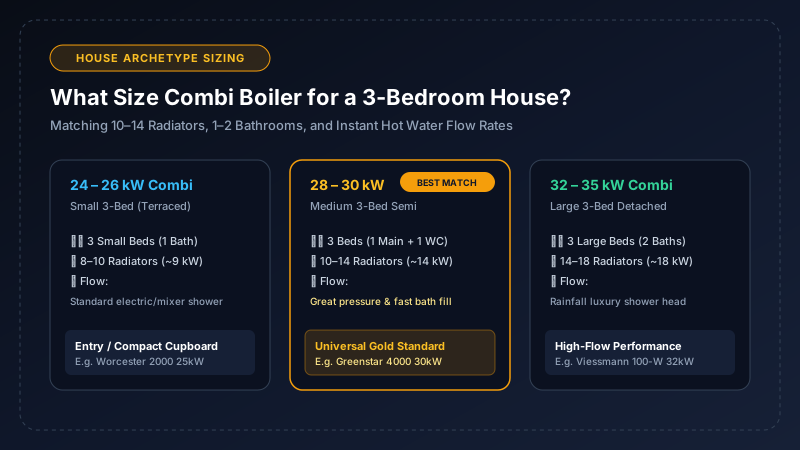
A 3-bedroom house is the single most common residential property type across the UK and Ireland—accounting for nearly 45% of all private housing stock.
Yet, when homeowners set out to replace an aging boiler, they are routinely presented with wildly conflicting recommendations:
- One installer quotes a compact 24 kW Combi, claiming it is “plenty for 10 radiators.”
- Another quotes a 30 kW Combi, calling it the “standard benchmark.”
- A third insists on a heavy 35 kW Combi, arguing you need “extra punch for fast bath filling.”
Who is right?
The answer requires understanding the fundamental mechanical difference between your home’s space heating demand (which is small) and your instantaneous hot water demand (which is large).
In this comprehensive engineering guide, we break down the thermodynamics of combi sizing for 3-bedroom houses, analyze shower flow rates, and provide a clear model selection framework.
1. Space Heating Load vs. Domestic Hot Water (DHW) Demand
To size a combi boiler correctly, you must evaluate two completely independent thermal loads:
A. The Space Heating Load (Radiators)
On a freezing winter day with an outdoor temperature of -3°C (27°F):
- A typical 1970s–1990s 3-bedroom semi-detached house (approx. 95 m² to 120 m²) with cavity wall insulation and double glazing has a whole-house heat loss of only 7.5 kW to 10.5 kW.
- A modern post-2006 Building Regs Part L 3-bed home loses only 5.5 kW to 7.0 kW.
Even with 12 to 14 double-panel radiators running simultaneously, a tiny 12 kW boiler could easily heat the entire house.
B. The Domestic Hot Water Load (Instant Showers)
Unlike traditional system boilers that store water in a cylinder, a combi boiler heats cold water instantly on-demand through a plate heat exchanger as it flows to your taps.
When you step into a morning shower:
- Cold mains water enters the property at approximately 10°C (50°F).
- You expect a comfortable shower temperature of 42°C to 45°C (108°F–113°F).
- The boiler must achieve a instantaneous 35°C temperature rise (Delta T) in a single pass.
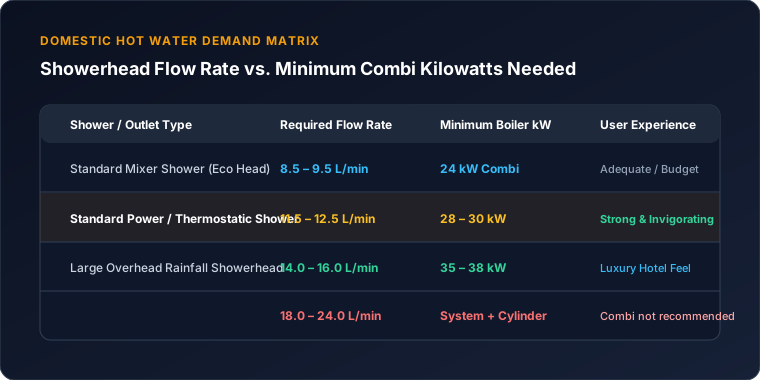
Under the standard thermodynamic water heating formula:
Required kW = (Flow Rate [L/min] × Delta T [°C] × 4.186) / 60- 24 kW Combi: Delivers 9.8 L/min (Adequate for standard electric or low-flow mixer shower).
- 28 kW to 30 kW Combi: Delivers 11.5 to 12.5 L/min (The universal gold standard for a strong, satisfying thermostatic shower).
- 35 kW to 38 kW Combi: Delivers 14.3 to 15.5 L/min (Required for large overhead rainfall showerheads or fast bath filling).
The Golden Rule of Combi Sizing:
Combi boilers are sized for your shower, NOT your radiators. Your central heating needs only 8 kW to 12 kW; the remaining 18 kW to 22 kW is dedicated entirely to instant hot water delivery.
2. Radiator Output Sizing for 3-Bedroom Houses
To ensure the boiler can comfortably heat all rooms during peak winter cold snaps, calculate the total installed radiator wattage under BS EN 442 (Delta T 50):
Typical 3-Bedroom Semi-Detached Room Schedule
| Room Location | Radiator Size & Type | Output at Delta T 50 (Watts) | Output in BTU/hr |
|---|---|---|---|
| Living Room (Front) | 600mm × 1200mm Type 22 (K2) | 1,760 W | 6,005 BTU/hr |
| Dining Area / Kitchen | 600mm × 1000mm Type 22 (K2) | 1,465 W | 5,000 BTU/hr |
| Hallway / Entrance | 600mm × 800mm Type 11 (K1) | 680 W | 2,320 BTU/hr |
| Downstairs Cloakroom WC | 600mm × 400mm Type 11 (K1) | 340 W | 1,160 BTU/hr |
| Master Bedroom | 600mm × 1000mm Type 21 (P+) | 1,150 W | 3,925 BTU/hr |
| Bedroom 2 (Double) | 600mm × 900mm Type 21 (P+) | 1,035 W | 3,530 BTU/hr |
| Bedroom 3 (Single/Box) | 600mm × 600mm Type 11 (K1) | 510 W | 1,740 BTU/hr |
| Family Bathroom | 1200mm × 500mm Heated Towel Rail | 450 W | 1,535 BTU/hr |
| Landing | 600mm × 600mm Type 11 (K1) | 510 W | 1,740 BTU/hr |
| Total Sum of Radiators | 9 Emitters Total | 7,900 Watts (7.9 kW) | 26,955 BTU/hr |
Adding a standard 15% distribution pipework allowance:
Total Space Heating Demand = 7.9 kW × 1.15 = 9.08 kW
Any standard combi boiler rated between 24 kW and 32 kW provides massive central heating headroom, easily covering this 9.1 kW load with power to spare.
3. The 3 Sizing Tiers: Which One Fits Your 3-Bed House?
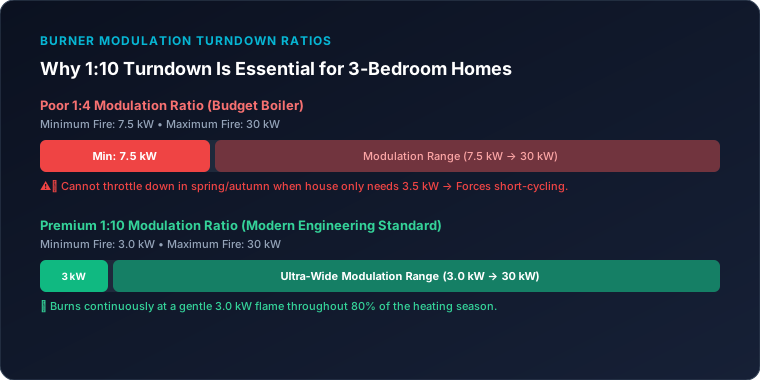
Tier 1: 24 kW – 26 kW Combi Boiler
- Best For: Small 3-bedroom terraced houses or starter semi-detached homes with 1 small bathroom and an electric or low-flow mixer shower.
- DHW Performance: 9.5 to 10.2 L/min.
- Pros: Lower purchase price, compact cupboard dimensions.
- Cons: Slower bath fill times (approx. 14 minutes for a 150L bath); shower stream feels weak if an eco-restrictor is not fitted.
Tier 2: 28 kW – 30 kW Combi Boiler (⭐ The Universal Sweet Spot)
- Best For: Standard 3-bedroom semi-detached and detached homes with 1 main family bathroom plus an ensuite or downstairs WC.
- DHW Performance: 11.5 to 12.5 L/min.
- Pros: Strong, invigorating shower pressure; fast bath fill (approx. 9–10 minutes); optimal balance of fuel economy and performance.
- Verdict: Recommended by 90% of chartered heating engineers for typical 3-bed properties.
Tier 3: 32 kW – 35 kW Combi Boiler
- Best For: Large 3-bedroom detached homes with 2 full bathrooms (used sequentially), a large soaking tub, or a high-flow overhead rainfall showerhead.
- DHW Performance: 13.5 to 14.5 L/min.
- Pros: Hotel-quality shower pressure.
- Crucial Requirement: Must choose a model with 1:10 modulation turndown (bottoming out at 3.0 to 3.5 kW) to prevent burner short-cycling during mild autumn weather.
4. Top Recommended Combi Models for 3-Bed Houses
When selecting a 28 kW to 32 kW combi, the most critical specification is modulation turndown. Premium modulating boilers include:
| Boiler Model | Max DHW Output | Max Heating Output | Modulation Ratio | Minimum Fire kW | Standard Warranty |
|---|---|---|---|---|---|
| Worcester Bosch Greenstar 4000 30kW | 30.2 kW (12.3 L/min) | 24.0 kW | 1:10 | 3.0 kW | 7–10 Years |
| Viessmann Vitodens 100-W 32kW | 32.0 kW (14.0 L/min) | 25.0 kW | 1:10 | 3.2 kW | 8–12 Years |
| Vaillant ecoTEC plus 832 | 31.8 kW (13.0 L/min) | 24.4 kW | 1:6 | 3.8 kW | 7–10 Years |
| Baxi 830 (with Adey Filter) | 30.0 kW (12.2 L/min) | 20.0 kW | 1:7 | 3.4 kW | 10 Years |
| Ideal Logic Max C30 | 30.3 kW (12.4 L/min) | 24.2 kW | 1:5 | 4.8 kW | 10 Years |
5. Critical Check: Testing Your Incoming Mains Flow Rate
Before purchasing a 30 kW or 35 kW combi boiler, you must perform a dynamic flow test on your incoming cold water mains:
The Mains Water Flow Law:
A 35 kW combi boiler capable of delivering 14.5 L/min cannot deliver more water than your lead/MDPE street mains pipe supplies. If your street pipe only delivers 10 L/min, installing a 35 kW boiler will NOT increase your shower pressure.
The 10-Second Flow Cup Test:
- Take a 1-litre or 2-litre measuring jug.
- Fully open your cold kitchen tap (which is directly connected to the incoming mains).
- Time how many seconds it takes to fill 1 Litre:
- Under 4 seconds: Flow is > 15 L/min (Excellent for 30–35 kW combi).
- 5 to 6 seconds: Flow is 10 to 12 L/min (Optimal for 28 kW combi).
- Over 7 seconds: Flow is < 8.5 L/min (Poor mains—consider a system boiler with an unvented cylinder or an accumulator tank).
Frequently Asked Questions
Can a combi boiler run two showers at the same time in a 3-bed house?
No standard domestic combi boiler can run two high-pressure thermostatic showers simultaneously without a noticeable drop in flow and temperature. If two showers turn on at once, the 12.5 L/min output will be split to ~6.2 L/min each. If simultaneous shower usage is a daily requirement, choose a System Boiler with an Unvented Cylinder.
What size boiler do I need if I have underfloor heating in the kitchen?
Because underfloor heating (UFH) operates at low flow temperatures (35°C to 45°C) and requires long continuous burns, ensure the combi has an ultra-wide 1:10 modulation turndown (e.g. Worcester Greenstar 4000 or Viessmann 100-W) so it can fire at a gentle 3 kW without short-cycling.
Related Sizing Tools:
Reviewed by James Davies, CEng MCIBSE
Lead heating consultant with 18+ years designing hydronic heating systems, district heat networks, and high-efficiency low-temperature heat pump integrations adhering to CIBSE and BS EN 12831 standards.